

Synthetic Fragrances in Cleaners: A Top Allergy Risk
Synthetic fragrances are in nearly every conventional cleaning product and they’re one of the most deceptive ingredients on this list. What's actually inside that single word "fragrance" on the label might surprise you.

There’s a reason cleaning product commercials always end with someone inhaling deeply and smiling. That scent - lemon, lavender, “spring breeze” - has been carefully engineered to feel like cleanliness itself. But what’s actually producing that smell is rarely a lemon or a lavender plant. It’s a proprietary chemical blend, often containing dozens of compounds that manufacturers are not required to disclose, and that researchers have linked to asthma attacks, allergic reactions, migraine headaches, and more.
Synthetic fragrances are collectively considered among the top five allergens in the world. Yet because the word “fragrance” on a label can legally conceal an entire formula, most people have no idea what they’re actually inhaling when they clean their homes.
The numbers on asthma and fragrance exposure:
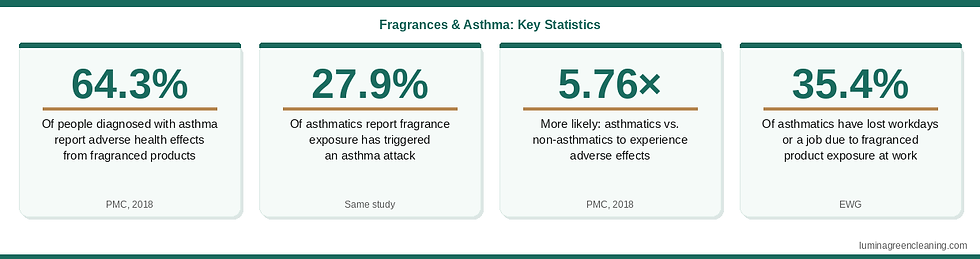
A nationally representative study of over 1,100 U.S. adults found that nearly 1 in 5 people in the general population reported health problems as respiratory issues, migraine headaches, mucosal symptoms, from exposure to fragranced cleaning products. Among asthmatics specifically, that number jumped to nearly two-thirds.
Cleaning products are a primary exposure route.
WHY “GREEN” ISN’T ENOUGHMany eco-branded and “natural” cleaning products still contain synthetic fragrance blends. A product can be plant-derived, biodegradable, and certified in various ways and still include an undisclosed fragrance formula with allergenic compounds. The only reliable protection is fragrance-free not “natural scent,” not “essential oil fragrance,” but genuinely fragrance-free with full ingredient transparency. |
Over time, a person can develop fragrance sensitivity to a widening range of compounds, meaning what started as mild irritation from one product can eventually become a reaction to fragranced products across the board, in any environment.
For people who already have asthma or chemical sensitivities, this spiral is particularly dangerous. The immune system becomes trained to respond, and the response gets harder to control.
We don't use scented products to signal cleanliness because a clean home doesn't have a manufactured smell.
WHAT WE DO DIFFERENTLY AT LUMINA
We don't use scented products to signal cleanliness because a clean home doesn't have a manufactured smell. Every product in our toolkit goes through a research process before it ever comes through a client's door. We look at full ingredient disclosure, third-party certifications like EPA Safer Choice and EWG Verified, and what the science says about long-term exposure. Fragrance-free isn't a limitation for us, it's a standard we set on purpose.
Love,
Alex
Lumina Cleaning & Organizing
© 2026 Lumina Cleaning and Organizing. All rights reserved. Terms & Conditions
Sources
Steinemann et al. (2018) — “Fragranced consumer products: effects on asthmatics,” PMC / Air Quality, Atmosphere & Health
Steinemann (2016) — “Fragranced consumer products: exposures and effects from emissions,” PMC / Air Quality, Atmosphere & Health
Ratcliffe et al. (2023) — “Do synthetic fragrances in personal care and household products impact indoor air quality and pose health risks?” PMC
Environmental Working Group — Guide to Healthy Cleaning: Allergens and Irritants (ewg.org)
Wieck et al. (2018) — Fragrance allergens in cleaning and personal care products, ScienceDirect
Evaluation of pollutants in perfumes and health effects — PMC / Journal of Environmental Health Science & Engineering (2022)


Comments