

Bleach Is in Almost Every Home. Here's What It's Doing to Your Health

Chlorine bleach is one of the most trusted names in household cleaning and one of the most studied respiratory hazards in the home.
It's under your sink right now. In the spray bottle you use on bathroom tiles, in your laundry routine, in the disinfectant wipe from the last cold season. Chlorine bleach is so embedded in our idea of "clean" that questioning it feels almost strange.
But researchers have been studying bleach's effects on the respiratory system for decades. For people living with asthma, allergies, or chemical sensitivities, regular exposure isn't just an irritant. It can be a genuine health risk quietly making a manageable condition worse.
Do you want to know why we don’t use Bleach at Lumina?
Here's something most people don't realize: when bleach contacts a surface, it off-gases a mixture of compounds that are toxic, carcinogenic, and highly irritating to the airways, including chlorine gas. Think chlorine gas, the stuff that makes your eyes water and your throat burn. Plus chloroform and carbon tetrachloride, two chemicals that researchers have linked to cancer risk in humans.These aren't exotic industrial compounds. They form in your bathroom every time you spray bleach on the tub.
ATTENTION!NEVER MIX THESE!Mixing bleach with any ammonia-based cleaner or with acidic cleaners like vinegar creates extremely high concentrations of chlorine gas. This can cause a person with no prior respiratory history to develop asthma after a single exposure. It has also caused deaths. When in doubt, never mix cleaning products. |
What the research says
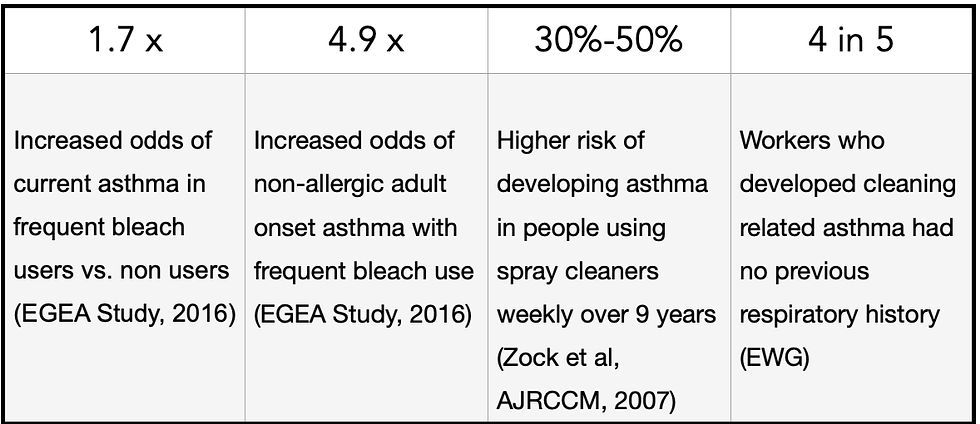
Spray bottles make it worse
The format matters just as much as the formula. When you spray bleach, you aerosolize it, turning the liquid into fine particles that travel deep into the lungs. That creates far more respiratory exposure than applying a product directly to a surface with a cloth. Multiple studies have flagged bleach sprays specifically as higher-risk than wiped or poured applications, yet spray bottles are exactly how most bleach products are packaged and sold.
What about children?
Children born to women who used cleaning products frequently during pregnancy showed higher rates of persistent wheezing and reduced lung function, effects that persisted for at least eight years. A Canadian birth cohort study also linked frequent cleaning product use in the first months of life to increased asthma risk by age three.
What we do differently at Lumina
We don't use chlorine bleach in any of our cleaning work and that's been the case from day one. Effective disinfection doesn't require it. There are alternatives that sanitize just as well without the respiratory tradeoff, and those are what we use. We know what's in every product we bring into your home, and we're always happy to share that with you.
Love,
Alex
Lumina Cleaning & Organizing
Sources
Environmental Working Group — Guide to Healthy Cleaning: Asthma & Respiratory Risks (ewg.org)
Leynaert et al. (2016) — "Women using bleach for home cleaning are at increased risk of non-allergic asthma," Respiratory Medicine
Zock et al. (2007) — "Cleaning sprays and adult asthma: an international longitudinal study," AJRCCM
Zock et al. (2009) — "Domestic use of hypochlorite bleach, atopic sensitization, and respiratory symptoms in adults," JACI
Dumas et al. (2020) — "Association of use of cleaning products with respiratory health in a Canadian birth cohort," CMAJ
Quirce & Barranco (2010) — "Cleaning Agents and Asthma," Journal of Investigational Allergology and Clinical Immunology
© 2026 Lumina Cleaning and Organizing. All rights reserved. Terms & Conditions


Comments