

The Paper Pile Problem: How to Finally Get Ahead of It

Paper is one of those things that accumulates faster than it should and slower than you notice. One day the counter is clear. A few weeks later there's a stack you're not sure how to start. And the longer it sits, the harder it feels to touch.
The good news is that paper piles aren't a personality flaw. They're a systems problem. And systems problems have solutions.
The First Rule: Don't Put It Down Without a Decision
The pile usually starts the same way. Mail comes in, gets set on the counter "for now," and stays there. School papers land on the kitchen table and get shuffled around for a week. A bill arrives and gets placed somewhere visible so you don't forget it; and then you forget it anyway.
Postponing the decision is the problem. Not the paper itself. |
The fix is simple but it requires a habit: paper that comes into the home gets dealt with immediately, or it goes directly into a designated spot that gets dealt with on a schedule. Not the counter. Not the table. A specific place with a specific purpose.
Set Up a Landing Zone for Mail
Give incoming mail one home. A small tray, a wall-mounted organizer, a dedicated drawer; whatever works for the space. The point is that mail goes there and only there until it's processed.
When the mail comes in, sort it on the spot into three categories: shred, recycle, and keep. Most of what arrives every day falls into the first two. Junk mail, expired offers, and envelopes don't need to make it past the recycling bin. Anything with personal information: account numbers, your full name and address goes straight to the shredder.
What's left is what actually needs attention. That pile should be small. If it isn't, the marketing mail section below is worth reading.
School Papers: A Weekly Reset
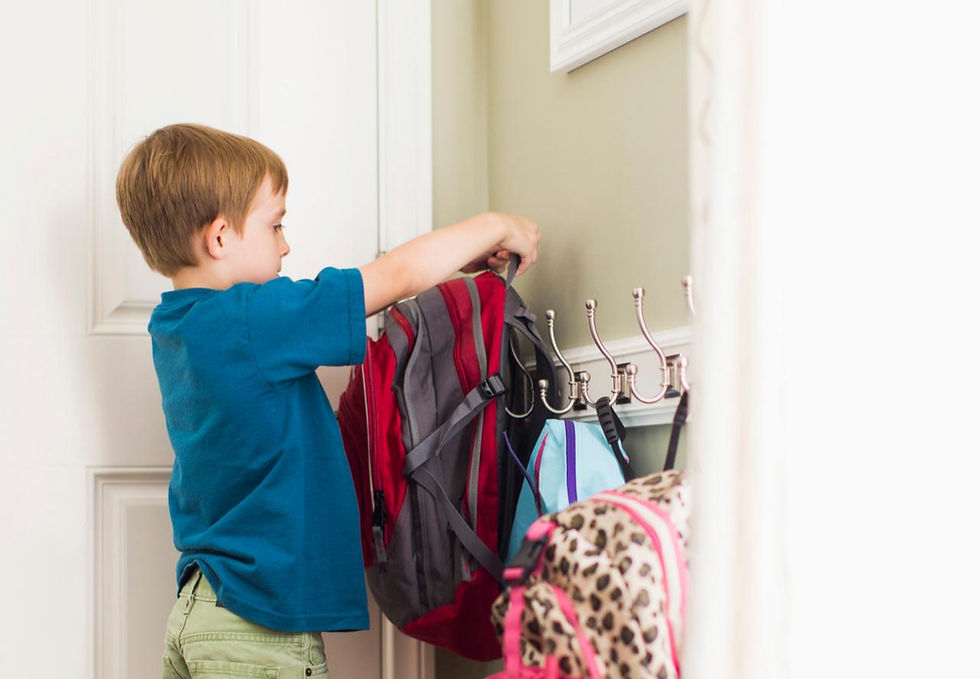
School papers are their own category and they need their own rhythm. Without one, the backpack becomes an archive and the kitchen table becomes an overflow filing system.
A weekly reset works well for most families. Sunday evening or Monday morning are natural moments, the week is either just ending or just beginning, and clearing the paper load before it carries over feels manageable. The goal isn't to save everything. It's to make a quick decision on each piece: does this need action, does it need to be saved, or is it done?
Artwork and assignments worth keeping can go into a designated folder or box, one per child, one academic year. Everything else can go. Can't bring yourself to let a drawing go? Photograph it. The memory stays. The paper doesn't have to.
At the end of the school year, do a full clear-out. Go through the folder, keep what genuinely matters, and recycle everything else. A year's worth of paper is much easier to sort through than three years.
Marketing Mail: How to Stop It Before It Starts
The most effective thing you can do for paper clutter is reduce how much comes in. Marketing mail is the easiest place to start.
A few simple steps make a real difference. Opting out of prescreened credit card and insurance offers can be done through OptOutPrescreen.com. It's a centralized opt-out website run by the four major credit bureaus: Equifax, Experian, TransUnion, and Innovis. Catalog and mailing list opt-outs can be handled through DMAchoice.org. It takes about fifteen minutes and the results show up within a few weeks.
For anything that keeps arriving anyway, calling the company directly and asking to be removed from their mailing list usually works. It's worth the two-minute call.
Going Digital Where It Makes Sense
A lot of what used to require a physical file doesn't anymore.
Medical bills, insurance explanations, and utility statements are almost always available through an online account or app. Signing up for paperless billing eliminates an entire category of incoming paper. Bank statements, investment summaries, and tax documents can be stored securely in a cloud folder and accessed when needed without taking up physical space.
For medical records specifically, most providers now offer patient portals where documentation lives digitally and can be downloaded if needed. There's no reason to maintain a paper file for something you can pull up on your phone in thirty seconds.
The goal isn't to go completely paperless overnight. It's to look at each category of paper that regularly enters the home and ask whether it actually needs to be physical and more often than not, it doesn't.
What to Actually Keep and File
For the paper that does need to stay, keep the system simple. A small accordion folder or a few labeled folders in a single drawer covers most households. Categories worth having: important documents, active bills or contracts, medical, and taxes. That's usually enough.
The rule for filing is the same as everything else in organizing: if it doesn't have a specific home, it won't get put away. A clear, simple system that takes two seconds to use will always beat an elaborate one that requires effort to maintain.
Paper piles are not inevitable. They're the result of a few habits that compound quickly and a system that was never quite put in place. Once the landing zone exists, the sorting habit kicks in, and the digital alternatives reduce the incoming load, the counter stays clear almost on its own.
That's the point of a system. It does the work so you don't have to keep doing it.
Love,
Alex
Lumina Cleaning & Organizing
© 2026 Lumina Cleaning and Organizing. All rights reserved. Terms & Conditions


Comments