

The One-Touch Rule: What It Is and Why It Fails Without a System

There's advice that sounds simple but falls apart the moment you actually try to live by it. The one-touch rule is one of them.
The idea is clean: when you pick something up, you take it directly to where it belongs, in one move, without setting it down somewhere else first. You walk in the door, you hang up your coat. You finish with the scissors, you put them back in the drawer. You open the mail, you deal with it on the spot. One touch, one trip, done. No pit stops, no temporary surfaces, no "I'll get to it later."
The rule was originally developed for the workplace, first attributed to productivity consultant Ann Gomez. It has since found its way into home organizing conversations as one of the most repeated pieces of advice in the field. (LivingEtc, March 2023)
It's one of those ideas that sounds almost too simple to be useful, until you realize how rarely most of us actually do it. And it makes sense in theory. The problem isn't the rule. The problem is what happens when you try to follow it in a home where nothing has a designated place yet.
What the Rule Assumes (But Never Says)
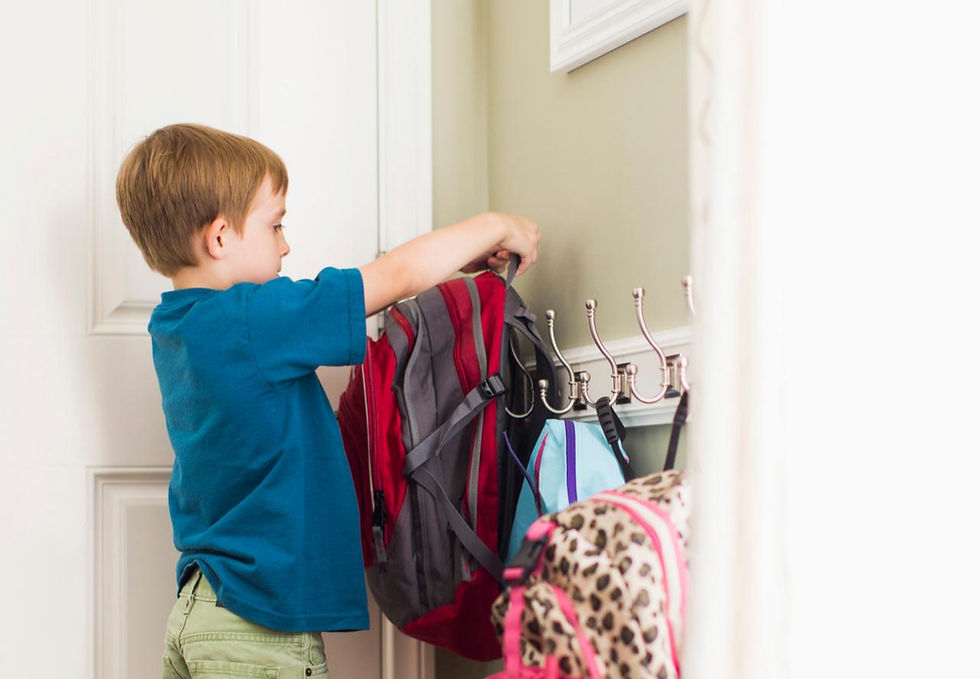
The one-touch rule quietly assumes your home already has a complete, intuitive system underneath it. It assumes that when you pick up your gym bag, the charger, the stack of mail, or the school paperwork, there is already a clear and logical home for each of those things. A specific drawer. A labeled bin. A hook you actually use.
Professional organizer Ben Soreff puts it directly: "While the one-touch rule may be helpful once you're organized and everything in your space has a home, I don't recommend using it during the process of getting organized itself." (Ben Soreff, House to Home Organizing, via LivingEtc, March 2023)
That's the gap most people fall into. They've heard the rule, they try to implement it, and then they pick up an item and freeze, because there's no system telling them where it goes.
What Your Brain Does When There's No Designated Place
That moment of freezing isn't laziness. It's your brain hitting a wall.
Every decision you make throughout the day, big or small, draws from the same mental energy pool. By the time you're home in the evening, that pool is running low. When you pick up an object and there's no clear place for it, you're not just deciding where to put it. You're asking your brain to generate, evaluate, and commit to a storage decision on the spot, often at the end of a full day when your cognitive reserves are already depleted. When that reserve runs low, even straightforward choices feel harder, and the brain defaults to the easiest available behavior. Which is: set it down. Somewhere. Deal with it later. (Taylor's University, 2025)
And then it sits there.
The item on the counter doesn't disappear from your awareness just because you stopped looking at it. It lingers. And your brain keeps spending small amounts of energy filtering it out, which, over time, adds up. (Nurture Your Nature, 2025)
There's also a physical side to this. A peer-reviewed UCLA study found that people who described their homes with words around clutter and feeling unfinished showed measurably flatter cortisol patterns across the day, a profile linked to worse health outcomes. Cortisol is a stress hormone. Clutter isn't just annoying. It's stressful at a biological level. (Saxbe & Repetti, Personality and Social Psychology Bulletin, 2010 — PubMed PMID: 19934011)
That's exactly what a system solves. It converts an active decision — where does this go? — into a passive behavior — I already know where this goes. When every item has a dedicated home, you eliminate the small but cumulative decisions that quietly exhaust you. The organizing system isn't aesthetic. It's doing neurological work so your brain doesn't have to. (St. Louis Closet Co., 2026)
Why Systems Are the Rule's Missing Piece
A system, in the context of home organizing, means that every category of item has a defined location and that location makes sense given how the space is actually used. It accounts for traffic patterns, habits, and the realistic way people move through a room.
Research suggests that when people are given opportunities to arrange their environments, they often reconfigure them to make frequently accessed objects more accessible, and that spatial organization helps reduce task-related cognitive demands. (Jury et al., PLOS ONE, 2022 — ncbi.nlm.nih.gov/pmc/articles/PMC8958644)
Once a home is organized at the system level, categories defined, locations assigned, zones established - the one-touch rule actually works. Because there's somewhere logical to take things.
Without that foundation, you're not following a rule. You're improvising, repeatedly, with a depleted brain.
At Lumina, we treat organizing and cleaning as distinct services for exactly this reason.
Organizing is what gives a home its logic. It's the work of deciding where things live, why they live there, and whether the space reflects how you actually move through it. Without that foundation, no rule or habit will hold for long.
With it, the one-touch rule stops being something you have to remember. You pick something up, you know where it goes, you take it there. The friction that used to make you set it down and walk away is just gone. That's not willpower. That's a system doing its job.
Love,
Alex
Lumina Cleaning & Organizing
© 2026 Lumina Cleaning and Organizing. All rights reserved. Terms & Conditions
Sources
Saxbe, D. & Repetti, R. (2010). No place like home: Home tours correlate with daily patterns of mood and cortisol. Personality and Social Psychology Bulletin. PubMed PMID: 19934011.
Chib, V. et al. (2025). The neurobiology of cognitive fatigue and its influence on effort-based choice. Journal of Neuroscience. https://www.jneurosci.org/content/jneuro/early/2025/05/08/JNEUROSCI.1612-24.2025.full.pdf
Maas, J. et al. (2025). Interruption, recall and resumption: a meta-analysis of the Zeigarnik and Ovsiankina effects. Humanities and Social Sciences Communications (Nature Portfolio). https://www.nature.com/articles/s41599-025-05000-w
Jury, M. et al. (2022). To organise or not to organise? Understanding search strategy preferences using Lego building blocks. PLOS ONE. https://www.ncbi.nlm.nih.gov/pmc/articles/PMC8958644/
Soreff, B. (quoted). House to Home Organizing. Via LivingEtc, March 2023. https://www.livingetc.com/advice/one-touch-decluttering-tip


Comments